JAPAN IN
ONE MINUTE 
~ The Story of Maneki Neko: How Japan’s Lucky Cat Became a Symbol of Good Fortune ~
Hey Issy, today when I was walking down the street, I saw a cat at the entrance of a shop!
It was moving its paw, so I thought it was real and got closer, but it turned out to be a statue!
Hahaha, that might have been a “maneki-neko“.
“Maneki-neko“? Is that Pecco’s sibling?
No, not at all. “Maneki” means “inviting” and “neko” means “cat”.
It’s a figurine believed to bring good luck and prosperity.
But why is it moving its paw?
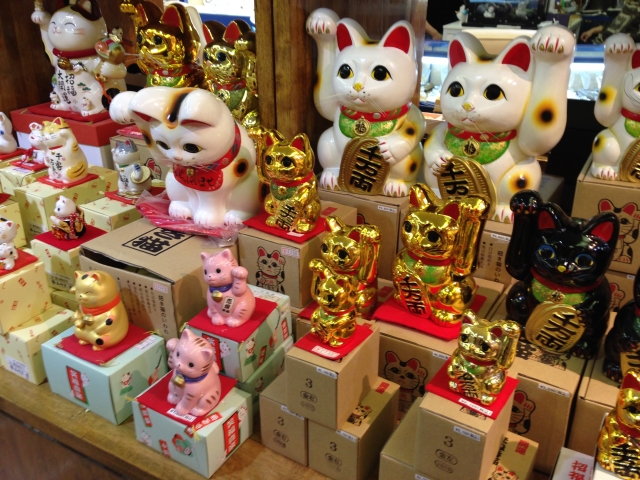
“Maneki-neko” is usually shown with one paw raised. If the right paw is raised, it’s said to invite money.
If the left paw is raised, it invites people, like customers.
There are also different colors.
Gold: brings money
White: brings good luck and health
Black: avoid bad luck
Pink: brings luck in love
But why a cat? Wouldn’t a dog have worked too?
Of course, it’s because cats are superior, right?
Hahaha, it’s not so much that they’re superior. It’s more that Japanese people have loved cats since long ago.
There are records that cats have been kept in urban areas since the Edo period.
The most famous origin story comes from a temple in Edo (old Tokyo).
It is said that a cat invited a poor traveler into the temple.
Soon after, the traveler was saved from danger, such as lightning or heavy rain, by entering the temple.
Later, this traveler turned out to be wealthy and brought great fortune to the temple.
From this story, the cat became a symbol.
Wow, so it’s not just a cute decoration!
I thought it was simply a smiling cat, but it has deep meaning.
Alright then, I’ll wave both hands and get money and popularity!
Haha, maybe you’re our real life “maneki-neko“, Pecco!
Summary
“Maneki-neko” is a Japanese figurine believed to bring good fortune, often seen with one paw raised to invite money or customers. With different colors symbolizing various types of luck, its origins trace back to Edo period stories.